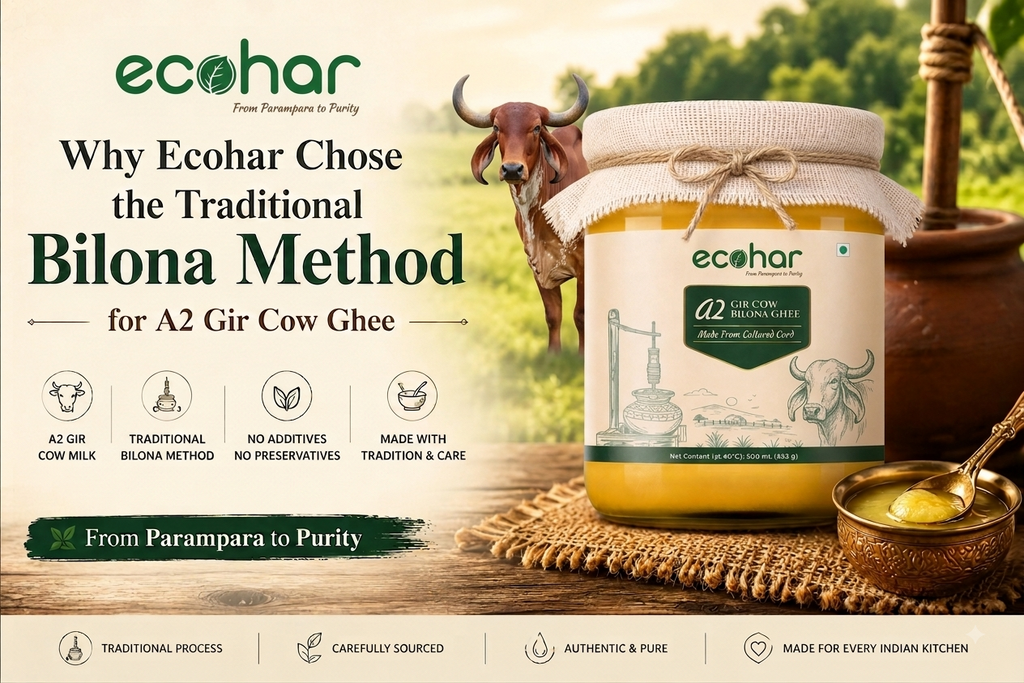
Why Ecohar Chose the Traditional Bilona Method for A2 Gir Cow Ghee
In a world where food is increasingly produced for speed, scale and convenience, some traditions are worth preserving.
At Ecohar, we believe that ghee is more than just a cooking ingredient. It is a part of India's food heritage—a product that has been traditionally prepared in households for generations. That belief is at the heart of our approach to making Ecohar A2 Gir Cow Bilona Ghee.
Our philosophy is simple:
From Parampara to Purity.
This is why we chose the traditional Bilona method for our ghee instead of simply following the fastest or most industrial approach available.
The Story Behind Ecohar
Ecohar was created with a simple idea: to bring traditional Indian food practices into modern households while maintaining a strong focus on quality and transparency.
Today, consumers have access to countless varieties of ghee. However, not every ghee is made in the same way. The source of milk, manufacturing process, ingredients, quality controls and handling can all influence the final product.
We wanted Ecohar to stand for something specific.
We wanted to create a ghee that respects the traditional way of making it while being produced with the quality standards expected by today's consumers.
That led us to the Bilona method.
What Is the Traditional Bilona Method?
Bilona is a traditional Indian method of making ghee that involves several stages rather than directly processing cream or milk into ghee.
The traditional process broadly follows this journey:
Milk → Curd → Churning → Butter → Ghee
Fresh milk is first converted into curd. The curd is then traditionally churned to separate the butter from the buttermilk. The collected butter is subsequently heated to produce ghee.
This process requires more time, attention and handling than many modern production methods.
For Ecohar, that is precisely the point.
We don't believe traditional food should be changed simply because there is a faster way to produce it.
Why Did Ecohar Choose Bilona?
The answer is rooted in our brand philosophy.
1. Respecting India's Ghee-Making Tradition
Ghee has been an important part of Indian kitchens for generations. Traditional households often made ghee from milk by first preparing curd, churning it into butter and then clarifying the butter.
The Bilona process represents this traditional approach.
By choosing Bilona, Ecohar aims to preserve the connection between the food we consume today and the food-making traditions passed down through generations.
2. A More Traditional Approach to Ghee
There are many ways to manufacture ghee at scale. Some approaches are designed primarily around efficiency and high-volume production.
Ecohar chose a process that stays closer to the traditional sequence of preparation.
The goal isn't to make exaggerated promises. It is simply to make ghee in a way that respects the traditional method.
For us, authenticity begins with the process.
3. Starting With A2 Gir Cow Milk
Ecohar A2 Gir Cow Bilona Ghee is positioned around milk from Gir cows, an indigenous Indian cattle breed.
The term "A2" refers to the type of beta-casein protein associated with the milk. However, it is important to understand that A2 is not a guarantee of specific health outcomes.
At Ecohar, we prefer to focus on what we can communicate clearly: the source, the process and the quality of the product.
We believe consumers deserve transparent information rather than exaggerated health claims.
From Milk to Ghee: Understanding the Ecohar Process
The traditional Bilona process can be understood through four important stages.
Step 1: Milk
The process begins with milk sourced from Gir cows.
Milk quality and sourcing are important because the final ghee can only be as good as the raw material used to make it.
Step 2: Curd
The milk is converted into curd.
This is an important part of the traditional Bilona approach because the process begins with curd rather than simply extracting cream and directly processing it into ghee.
Step 3: Churning
The curd is traditionally churned to separate butter from buttermilk.
This step is one of the defining characteristics of the Bilona process.
The butter obtained through this process becomes the base for the next stage.
Step 4: Clarification Into Ghee
The butter is then heated carefully until the moisture is removed and the characteristic golden ghee remains.
The result is the rich, aromatic product we know as ghee.
This traditional sequence is what gives Bilona ghee its distinctive identity.
Why Not Take a Shortcut?
At Ecohar, one of our core beliefs is reflected in a simple statement:
No Shortcut.
Making food traditionally can require more time and attention. But when a traditional process is central to the identity of a product, we believe it is worth respecting.
Our decision to use the Bilona method wasn't made because it sounds traditional on a label.
It was made because the process itself is an important part of what Ecohar stands for.
We want consumers to know that when they choose Ecohar A2 Gir Cow Bilona Ghee, they are choosing a product inspired by a traditional Indian method of preparation.
No Additives. No Preservatives.
Ecohar's product philosophy also focuses on keeping the product straightforward.
Our A2 Gir Cow Bilona Ghee is made without added preservatives or additives.
For us, simplicity matters.
Ghee is traditionally a simple product. It doesn't need a complicated ingredient list to have a place in your kitchen.
This is why we focus on transparency around what goes into the product and how it is made.
Traditional Wisdom Meets Modern Quality Standards
Choosing a traditional process doesn't mean ignoring modern quality expectations.
This is an important distinction.
Ecohar believes that traditional preparation and modern quality standards can coexist.
The Bilona method represents our connection to traditional food practices.
Quality checks, compliant manufacturing, appropriate packaging, product specifications and food-safety requirements represent our responsibility to the modern consumer.
We don't see these two ideas as opposites.
Instead:
Tradition defines how we approach the product.
Quality standards define how responsibly we bring it to you.
What Makes Ecohar Different?
The Indian ghee market has grown significantly, with consumers now having many options to choose from.
So why Ecohar?
Because we want our brand to stand for a clear set of principles.
Traditional Bilona Method
We follow a traditional approach to making ghee, where curd is churned to obtain butter before the butter is clarified into ghee.
A2 Gir Cow Ghee
Our flagship product is made from Gir cow milk and is positioned as A2 Gir Cow Bilona Ghee.
No Additives & No Preservatives
We keep the product philosophy simple, without adding preservatives or additives.
Focus on Transparency
We believe customers should be able to understand what they are buying, how it is made and what the product contains.
Respect for Indian Food Heritage
Ecohar isn't trying to reinvent ghee.
We're trying to preserve what makes traditional ghee meaningful while presenting it for today's consumer.
How Can You Use Ecohar Bilona Ghee?
Ecohar A2 Gir Cow Bilona Ghee can easily become part of everyday cooking.
You can use it for:
- Dal and tadka
- Roti and paratha
- Rice and khichdi
- Traditional Indian sweets
- Cooking and sautéing
- Finishing dishes
- Adding richness to everyday meals
A small spoonful can add the characteristic aroma and flavour associated with ghee.
The best part is that you don't need complicated recipes to enjoy it.
Sometimes, the simplest food is the most satisfying.
Is Bilona Ghee Worth Choosing?
That ultimately depends on what you value when buying ghee.
If your priority is simply finding the cheapest cooking fat available, traditionally made Bilona ghee may not be the obvious choice.
But if you value:
Traditional preparation
→ Carefully selected ingredients
→ Transparent product information
→ Premium positioning
→ Indian food heritage
then Bilona ghee can be an option worth considering.
Ecohar was created for consumers who appreciate this difference.
Our Philosophy: From Parampara to Purity
The name Ecohar represents more than a product.
It represents our attempt to bring traditional food practices into modern homes without losing their essence.
Our tagline, "From Parampara to Purity," captures this idea.
Parampara represents the traditions passed down through generations.
Purity represents our commitment to keeping the product simple, transparent and thoughtfully made.
Between these two ideas lies the Ecohar journey.
From traditional milk and curd-making practices to the Bilona process and modern quality standards, every stage reflects our belief that good food deserves respect.
The Ecohar Promise
We know that words like "traditional," "pure" and "premium" are easy to use.
That's why we believe a brand should be judged not only by what it says, but also by how transparently it communicates its product.
With Ecohar A2 Gir Cow Bilona Ghee, our approach is straightforward:
Traditional method.
A2 Gir Cow positioning.
No additives.
No preservatives.
Thoughtful quality standards.
No unnecessary shortcuts.
That's the kind of ghee we wanted to bring to our own kitchens—and ultimately, to yours.
Final Thoughts
Ghee has been part of Indian kitchens for generations. While technology has changed the way food is produced, the value of traditional food practices continues to inspire consumers looking for authentic products.
At Ecohar, choosing the Bilona method was therefore not just a marketing decision.
It was a conscious decision to stay connected to a traditional way of making ghee.
Ecohar A2 Gir Cow Bilona Ghee represents our effort to combine the wisdom of traditional Indian food preparation with the expectations of the modern consumer.
Because sometimes, moving forward doesn't mean leaving tradition behind.
Sometimes, it means carrying the best of it with you.
Ecohar — From Parampara to Purity.
-
Posted in
Bilona Ghee