Ecohar Janmashtami Special 2026: Celebrating Krishna’s Love for Makhan & Traditional Bilona Ghee
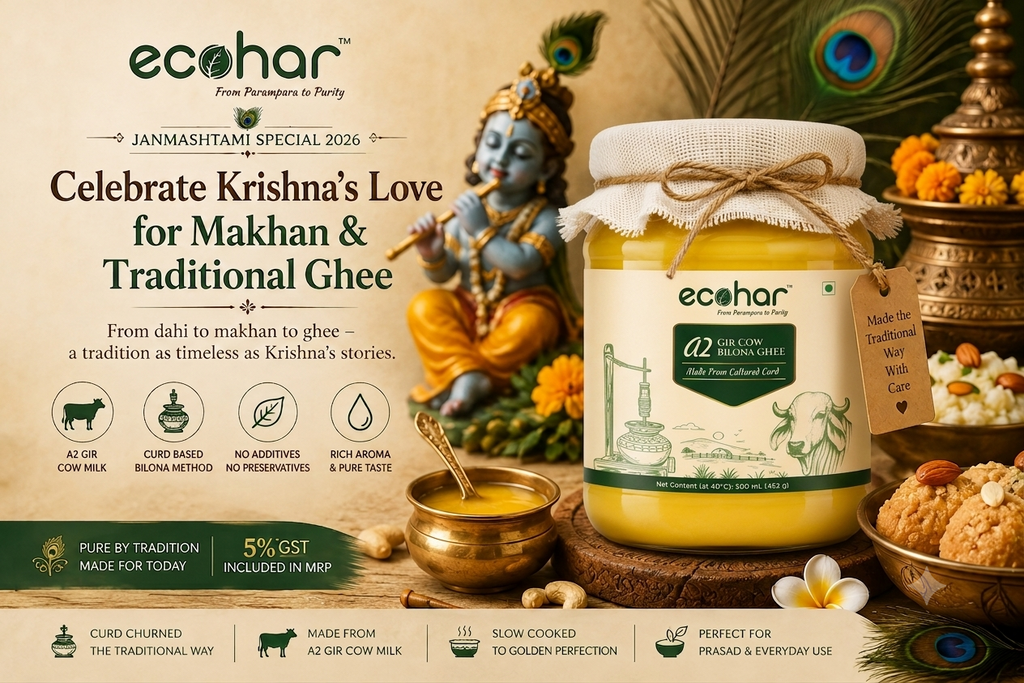
Janmashtami is not just a festival—it is a celebration of devotion, tradition, family, and the joyful stories of Lord Krishna that have been passed down through generations.
From beautifully decorated jhankis and midnight prayers to bhajans, fasting and homemade prasad, every Janmashtami tradition carries a special connection with our cultural roots.
And when we think about Bal Krishna, one thing immediately comes to mind—his love for makhan.
The stories of little Krishna stealing freshly churned butter from earthen pots earned him the affectionate name “Makhan Chor.” These stories are still lovingly told in Indian households today.
Interestingly, there is also a beautiful connection between Krishna's beloved makhan and one of the most treasured ingredients in Indian kitchens—ghee.
This Janmashtami, Ecohar celebrates that timeless journey from dahi to makhan and makhan to ghee, and the traditional food-making practices that continue to connect generations.
Why Do We Celebrate Janmashtami?
Janmashtami, also known as Krishna Janmashtami or Gokulashtami, celebrates the birth of Lord Krishna, traditionally regarded as the eighth avatar of Lord Vishnu.
The festival is celebrated across India in different ways.
Homes and temples are decorated with flowers and lights. Families create jhankis depicting scenes from Krishna's childhood. Devotees observe fasts, sing bhajans and prepare special foods as offerings.
Midnight holds particular significance in Janmashtami celebrations, as Krishna's birth is traditionally associated with the midnight hour.
In several regions, celebrations also include Dahi Handi, inspired by the stories of young Krishna and his friends reaching for pots filled with curd and butter.
This association makes dairy foods such as dahi, makhan and ghee deeply connected with the stories and food traditions surrounding Janmashtami.
Krishna and Makhan: A Timeless Story
The image of Bal Krishna holding a pot of freshly churned butter is one of the most recognisable representations of his childhood.
According to traditional stories, Krishna loved makhan so much that he and his friends would mischievously find butter stored in the homes of Gokul.
This playful side of Krishna is why he came to be lovingly called Makhan Chor.
But the makhan described in these traditional stories was very different from the commercially processed butter most of us see today.
Traditionally, households would prepare curd from milk and then churn the curd using a mathani or bilona.
During churning, fresh butter—or makhan—would separate from the buttermilk.
That makhan could then be slowly heated to prepare ghee.
So there is a beautiful traditional journey:
Milk → Dahi → Bilona Churning → Makhan → Ghee
It is this traditional process that inspires Ecohar A2 Gir Cow Bilona Ghee.
What Is Traditional Bilona Ghee?
The word Bilona refers to the traditional churning method historically used in Indian households for preparing butter from curd.
Instead of starting directly with separated cream, the traditional process begins by converting milk into curd.
The curd is then churned to separate butter.
The obtained butter is slowly heated until the moisture evaporates and the milk solids separate, leaving behind aromatic golden ghee.
The process can be understood simply as:
Step 1: Milk
The process begins with milk.
Step 2: Curd
The milk is cultured and converted into dahi or curd.
Step 3: Bilona Churning
The curd is churned to separate butter from buttermilk.
Step 4: Makhan
Fresh butter obtained through the churning process is collected.
Step 5: Ghee
The butter is slowly heated and transformed into ghee.
It takes more time and effort compared with processes that start directly from cream, but it preserves a preparation method deeply rooted in Indian food traditions.
Ecohar A2 Gir Cow Bilona Ghee: From Parampara to Purity
At Ecohar, our philosophy is represented by four simple words:
From Parampara to Purity.
Ecohar A2 Gir Cow Bilona Ghee is made from Gir cow milk using a traditional curd-based Bilona process.
Instead of starting directly with separated cream, milk is converted into curd. The curd is churned to obtain makhan, which is then slowly heated to prepare ghee.
For us, the process is just as important as the final product.
We want to keep traditional Indian food-making practices relevant for modern households without losing the essence that made these foods special in the first place.
That is the thought behind Ecohar.
Why Ghee Has a Special Place in Indian Festivals
Ghee has been part of Indian kitchens for generations and holds an especially important place in festive cooking.
Think about the unmistakable aroma when atta begins roasting in warm ghee.
The richness of homemade laddoos.
The flavour of roasted makhana and dry fruits.
Or that final spoonful of ghee added to a warm festive meal.
In many traditional recipes, ghee isn't simply used for cooking—it contributes significantly to the aroma, texture, richness and overall character of the dish.
During Janmashtami, when many families prepare homemade prasad and festive dishes, choosing good-quality ingredients becomes particularly meaningful.
6 Janmashtami Special Recipes to Prepare with Ecohar Ghee
If you're planning your Janmashtami menu, here are some traditional and simple preparations where Ecohar A2 Gir Cow Bilona Ghee can add its characteristic richness and aroma.
1. Panjiri
Panjiri is commonly prepared during religious and festive occasions in many North Indian households.
Depending on the family recipe, ingredients such as flour, nuts, seeds and sugar are combined to create a rich and aromatic preparation.
When preparing atta-based panjiri, slowly roasting the flour in ghee is an important step.
Since ghee is one of the key ingredients, its aroma and flavour can noticeably influence the final result.
2. Makhana Kheer
Makhana kheer is a wonderful option for Janmashtami celebrations.
Before adding makhana to milk, lightly roast it with a little Ecohar A2 Gir Cow Bilona Ghee.
The roasting gives makhana a pleasant texture and nutty aroma.
Cook it with milk and finish with ingredients such as cardamom and nuts according to your preferred recipe.
3. Atta Halwa
Few recipes showcase ghee as beautifully as atta halwa.
Wheat flour is patiently roasted in ghee until it develops a beautiful golden colour and characteristic aroma.
The recipe itself may be simple, but patience and ingredient quality make a significant difference.
A spoonful of aromatic Bilona ghee can bring additional richness to the experience.
4. Besan Laddoo
Besan laddoo is another festive favourite where ghee takes centre stage.
Besan is slowly roasted with ghee until it becomes aromatic and develops the desired texture.
After cooling appropriately, sugar and other preferred ingredients are added before shaping the mixture into laddoos.
The aroma of freshly roasted besan and ghee is enough to make any kitchen feel festive.
5. Ghee-Roasted Makhana
Sometimes you don't need an elaborate recipe.
Simply roast makhana on low heat with a small amount of Ecohar Ghee until crisp.
Season it according to your fasting traditions and preferences.
It makes for a simple, crunchy festive snack.
6. Dry Fruit Panjiri
Dry fruits and nuts can be gently roasted in ghee before being combined with other ingredients to prepare a rich festive panjiri.
Every household has its own recipe, and that's part of the beauty of Indian festive cooking.
Recipes aren't merely instructions written on paper—they often carry memories from one generation to another.
How to Choose Ghee for Janmashtami
Today, consumers can choose from hundreds of ghee products, and packaging claims can sometimes make it difficult to understand the actual differences.
When buying ghee, particularly if you're looking for traditional Bilona ghee, consider a few important factors.
1. Read the Ingredient List
Always check what the product actually contains.
The label should clearly communicate the ingredient used.
2. Understand the Process
If you're specifically purchasing Bilona Ghee, try to understand how the brand prepares it.
Does the process begin with curd?
Is the curd churned to obtain butter?
Or does the process begin directly with cream?
Understanding the manufacturing method gives you much more information than simply relying on the word "Bilona" on the front of a pack.
3. Check the Milk Source
If you're purchasing Gir Cow Ghee, look for clear information about the type of milk used to prepare the product.
4. Don't Judge Ghee Only by Colour
The appearance of ghee can vary due to multiple factors.
Therefore, colour alone should not be treated as definitive proof of purity or quality.
5. Check the Label Carefully
Before purchasing packaged food, look for important information such as the ingredient list, FSSAI details, manufacturer information, nutritional information, net quantity, batch information and best-before/expiry information.
An informed purchase is always better than one based only on advertising claims.
Why Ecohar Chose the Traditional Bilona Route
Modern food manufacturing has made production faster and more scalable.
But at Ecohar, we believe some traditional methods are worth keeping alive.
The journey from milk to curd, curd to makhan and makhan to ghee beautifully represents the philosophy behind our brand.
We aren't trying to reinvent ghee.
Instead, we're looking back at the traditional knowledge that already existed in Indian households and bringing that philosophy to today's consumers.
That's why our message remains:
Ecohar — From Parampara to Purity.
Janmashtami: Where Food Connects Generations
Some of our strongest festival memories are connected with food.
Maybe it's watching your mother prepare panjiri.
Maybe it's your grandmother telling you exactly how long the flour should be roasted.
Maybe it's decorating a small Krishna jhanki with your children.
Or perhaps it's simply sitting together as a family, waiting for the midnight Janmashtami celebrations.
These moments become memories that stay with us.
Our kitchens may become more modern.
Our lifestyles may become faster.
Recipes may evolve.
But the emotions surrounding festive food remain surprisingly familiar.
At Ecohar, we want to celebrate exactly that connection between tradition, food and family.
Bring Ecohar to Your Janmashtami Celebration
This Janmashtami, as your home fills with prayers, laughter and the aroma of homemade festive food, celebrate the traditions that have travelled through generations.
From Krishna's beloved makhan to the traditional journey of curd-churned Bilona ghee, some food traditions carry stories much bigger than the ingredient itself.
Prepare your favourite Janmashtami dishes.
Share them with your family.
Pass your recipes to the next generation.
And keep the parampara alive.
Ecohar wishes you and your family a very Happy Janmashtami.