How to Identify Pure Cow Ghee: 7 Things to Check Before Buying
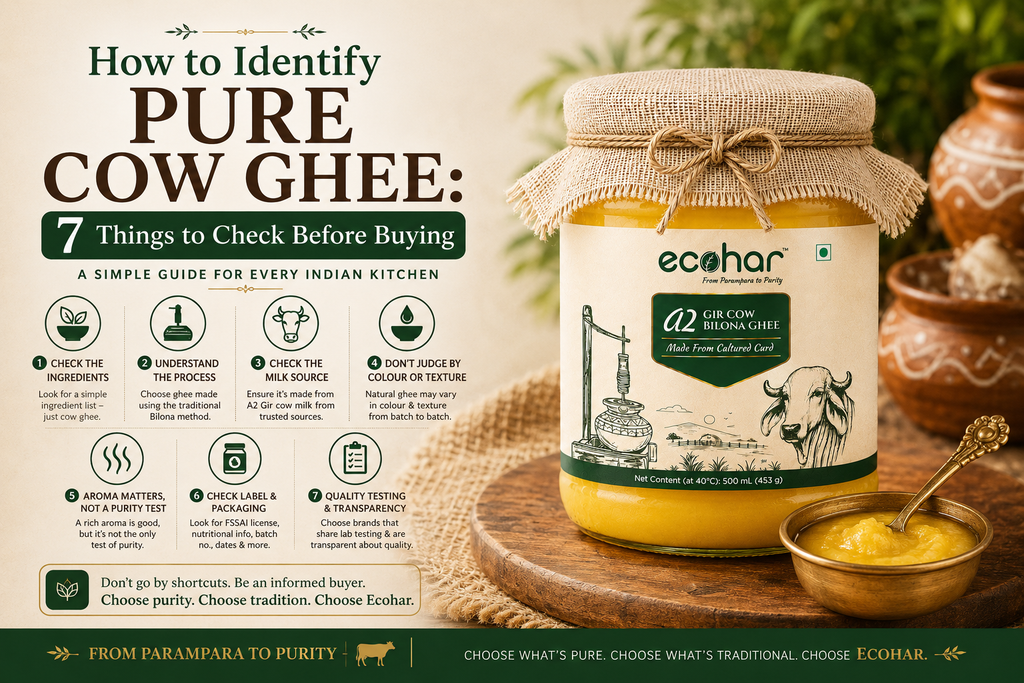
How to Identify Pure Cow Ghee: 7 Things to Check Before Buying
For generations, ghee has held a special place in Indian kitchens. It is used for tempering dal, spreading over rotis and parathas, preparing sweets, cooking festive meals, and adding richness to everyday dishes. For many families, ghee is more than just a cooking fat—it is part of food traditions passed from one generation to another.
But buying ghee today is very different from getting it prepared at home. Supermarket shelves and online marketplaces are filled with products described as pure cow ghee, desi ghee, A2 ghee, Gir cow ghee, traditional ghee and Bilona ghee. Attractive packaging and premium claims can make it difficult to understand what actually distinguishes one jar from another.
That leads to an important question: how can you identify pure cow ghee before buying it?
There is no single colour, aroma, texture or home trick that can conclusively establish the purity of ghee. A better approach is to evaluate several things together: the ingredient declaration, milk source, manufacturing process, packaging information, brand transparency and quality testing.
This guide explains 7 practical things you should check before buying cow ghee, especially when shopping online.
1. Read the Ingredient List Before Reading the Marketing Claims
The front of a ghee jar is designed to attract attention. Words such as pure, premium, traditional, natural and authentic may sound reassuring, but they should not be the only basis for your decision.
Turn the jar around and look at the ingredient declaration.
For a straightforward cow ghee product, the ingredient information should clearly indicate the dairy source used to make the ghee. If you are specifically buying cow ghee, make sure the label identifies it accordingly rather than relying only on imagery or branding on the front.
Also look for information about added flavours, colours, preservatives or other ingredients. If a brand claims that its ghee contains no additives or preservatives, the ingredient declaration should be consistent with that positioning.
The key principle is simple: the easier it is to understand what is inside the jar, the better informed your purchase decision can be.
What should you check on the ingredient panel?
-
Whether the product is clearly identified as cow ghee
-
Whether any additional ingredients are declared
-
Whether the ingredient information matches the claims made elsewhere on the packaging
-
Whether the label is clear and easy to understand
Do not judge a food product only by the largest words printed on the front. The smaller information on the back can often tell you much more.
2. Understand How the Cow Ghee Is Made
The manufacturing process is one of the most useful things to understand when comparing different types of ghee.
Not all ghee is prepared in exactly the same way. Modern commercial production can use cream or butter as the starting material, while traditional methods may begin with milk that is cultured into curd.
What is the traditional Bilona method?
In a traditional curd-based Bilona process, milk is used to prepare curd. The curd is then churned to separate butter, commonly called makkhan. That butter is subsequently heated carefully until the moisture is removed and ghee is obtained.
In simplified form, the journey looks like this:
Milk → Curd → Churning → Butter/Makkhan → Heating → Ghee
This is different from processes in which cream is separated from milk and used directly for ghee production.
Neither the word “cow ghee” nor “desi ghee” automatically tells you which manufacturing method was used. Therefore, if the production method matters to you, look for a brand that clearly explains it.
If you specifically want Bilona ghee, check whether the brand describes a curd-churning process instead of using “Bilona” simply as a prominent marketing term.
3. Check the Source of the Milk and the Cow Breed
The source of the raw material matters, particularly when you are paying a premium for a product marketed as A2 Gir Cow Ghee.
Gir cattle are an indigenous Indian breed historically associated with Gujarat and are easily recognised by characteristics such as their curved horns, long ears and prominent forehead.
When a product specifically claims to be made from Gir cow milk, look beyond the picture of a cow on the label. See whether the brand explains where its milk comes from, what type of cows are used and how the sourcing connects to the finished product.
Similarly, the term A2 is widely used in the dairy category. Consumers should avoid assuming that every product with “A2” written prominently on the front is otherwise identical in sourcing or production method.
Ask questions such as:
-
Which cow breed is the milk sourced from?
-
Does the brand clearly identify the milk source?
-
Is the ghee made from curd, cream or another dairy intermediate?
-
Does the company provide meaningful sourcing information beyond marketing claims?
Greater transparency does not require revealing every commercial detail. But a brand selling a premium traditional product should be able to clearly explain the basic journey from milk to ghee.
4. Understand the Colour and Texture of Pure Cow Ghee
One of the most common misconceptions is that pure cow ghee must always look exactly the same.
Consumers often expect ghee to be bright golden yellow and perfectly grainy. If a new jar looks slightly lighter, darker, smoother or more liquid than the previous one, they may immediately question its quality.
In reality, ghee is a dairy product, and its physical appearance can vary.
Why can ghee colour vary?
Colour can be influenced by several factors, including the raw material, feeding patterns, season and processing conditions. Cow ghee may commonly have a yellowish or golden appearance, but colour alone should never be treated as scientific proof of purity.
Extremely attractive golden colour is not automatically evidence of better-quality ghee either.
Why does ghee sometimes become grainy?
The granular structure of ghee can be influenced by the way it cools and crystallises after preparation. Storage temperature and temperature fluctuations can also affect whether the ghee appears grainy, smooth, semi-solid or partially liquid.
Why does ghee melt in summer?
Ghee responds naturally to temperature. During warmer weather it can become soft or liquid, while cooler temperatures can cause it to solidify.
That change by itself does not establish whether the product is pure or adulterated.
So remember:
Colour + texture can help you observe your ghee, but they cannot conclusively prove purity.
5. Smell and Taste Matter—but Don't Treat Them as Laboratory Tests
Traditional ghee is valued partly for its distinctive aroma and flavour. Opening a jar and smelling that rich dairy aroma is an important part of the experience for many consumers.
However, aroma is subjective.
Its intensity can depend on the raw material, culturing, heating conditions, production method and even storage. Two genuine batches of traditionally prepared ghee do not necessarily need to smell completely identical.
The same applies to taste.
A pleasant, characteristic flavour can tell you about your sensory experience, but taste alone cannot establish the chemical purity of a food product.
Be careful with viral “ghee purity tests”
You may find videos recommending tests involving your palm, refrigeration, melting behaviour, water, colour or smell.
Such demonstrations may be interesting, but consumers should not treat them as conclusive adulteration tests. Multiple factors can influence the physical behaviour of fats, and reliable detection of adulteration may require controlled analytical testing.
If you genuinely want evidence about quality parameters, laboratory testing is considerably more meaningful than a viral kitchen hack.
6. Inspect the Packaging and Mandatory Product Information
A beautiful jar can make a product look premium, but packaging should do much more than look attractive. It should provide enough information for you to understand what you are purchasing and identify the responsible food business.
Before buying cow ghee, especially from an unfamiliar online seller, inspect the product information carefully.
Depending on the applicable labelling requirements and product, relevant information can include:
-
Name and nature of the food
-
Ingredient declaration
-
Net quantity
-
Nutritional information
-
FSSAI licence details
-
Batch or lot identification
-
Date marking and shelf-life information
-
Manufacturer, packer or marketer details, as applicable
-
Consumer-care/contact information
-
Storage instructions
-
Vegetarian symbol and other applicable declarations
Also inspect the physical packaging after delivery. The lid or seal should not appear tampered with, the jar should not be damaged, and the label should be readable.
Proper packaging does not prove purity on its own, but missing or suspicious information is a reason to be cautious.
7. Look for Quality Testing and Genuine Brand Transparency
This may be the most important point of all.
Anyone can write “100% pure” in an advertisement. What matters is what sits behind that statement.
Quality testing allows relevant characteristics of ghee to be evaluated under controlled conditions. Depending on the testing scope and applicable standards, laboratories can analyse parameters associated with the composition and quality of ghee and investigate potential adulteration.
When evaluating a premium ghee brand, see whether it discusses its quality-control practices clearly rather than relying entirely on emotional claims.
Useful questions include:
Where does the raw material come from?
How is the ghee prepared?
What ingredients are used?
Who manufactures or packs it?
How is quality checked?
You do not need to become a food scientist before buying a jar of ghee. But a trustworthy brand should make it easier—not harder—for customers to understand the product.
Bonus: Does a Higher Price Mean Purer Ghee?
Not necessarily.
Traditional production methods, specific milk sourcing, smaller batches, packaging, testing and supply-chain costs can all make certain ghee products more expensive to produce.
But a premium price tag is not itself proof of purity.
At the same time, comparing ghee only on the lowest price per kilogram or litre may overlook meaningful differences in sourcing and manufacturing.
Instead of asking only “Which ghee is cheapest?” or “Which one is most expensive?”, ask:
“What exactly am I getting for this price?”
Compare the ingredient declaration, production method, source, packaging information, quality controls and transparency of the brand.
Common Myths About Identifying Pure Ghee
Myth 1: Pure ghee must always be yellow
Colour can vary. A particular shade alone cannot confirm purity.
Myth 2: Pure ghee must always be grainy
Granulation is influenced by crystallisation, cooling and storage conditions. Texture alone is not a definitive purity test.
Myth 3: Pure ghee never becomes liquid
Ghee naturally changes consistency with temperature. It may become liquid or softer in warm conditions and solidify in cooler conditions.
Myth 4: Strong aroma means the ghee is definitely pure
Aroma is influenced by several production factors and cannot independently establish purity.
Myth 5: Expensive ghee must be authentic
Price can reflect sourcing and production costs, but price alone provides no guarantee of purity.
A Simple Checklist Before Buying Cow Ghee Online
Before clicking Add to Cart, take a minute to check:
-
Ingredients: Is the ingredient declaration clear?
-
Type: Is it clearly identified as cow ghee?
-
Process: If it claims to be Bilona ghee, is the process explained?
-
Source: If it claims Gir cow or A2 sourcing, does the brand provide meaningful information?
-
Label: Are the key product and food-business details available?
-
Quality: Does the brand discuss quality control or testing?
-
Transparency: Can you understand who is behind the product and how it is made?
These checks are more useful than relying on a single visual characteristic or internet home test.
How Ecohar Approaches A2 Gir Cow Bilona Ghee
At Ecohar, our philosophy is simple: if we are asking customers to bring a traditional food into their homes, we should also be transparent about how we approach it.
Ecohar A2 Gir Cow Bilona Ghee is made using A2 Gir cow milk and a traditional curd-based Bilona process. The process begins with curd rather than taking a shortcut through a cream-based method. The curd is churned to obtain butter, which is then carefully transformed into ghee.
We keep the product straightforward, with no added preservatives or unnecessary additives, and quality testing forms part of our approach to product quality.
For us, “purity” should not exist only as a large claim on the front of a jar. It should be reflected in the ingredients, process and transparency behind the product.
That is the idea behind our promise:
From Parampara to Purity.
Frequently Asked Questions About Pure Cow Ghee
How can I identify pure cow ghee at home?
You can observe the aroma, appearance, texture and behaviour of ghee, but these characteristics alone cannot conclusively establish purity. Reading the label, understanding the source and process, and looking for credible quality testing are more dependable ways to evaluate a product.
Is yellow ghee always pure cow ghee?
No. Colour alone cannot establish purity. The shade of cow ghee can vary because of the raw material, season and processing conditions.
Is grainy ghee better than smooth ghee?
Graininess can result from the crystallisation and cooling behaviour of ghee. A grainy texture alone does not prove that one product is purer or better than another.
What is Bilona cow ghee?
Bilona generally refers to a traditional process in which curd is churned to separate butter and that butter is subsequently heated to prepare ghee. Consumers looking specifically for Bilona ghee should check whether the brand clearly describes a curd-based process.
What is A2 Gir Cow Ghee?
A2 Gir Cow Ghee generally refers to ghee marketed as being produced from milk sourced from Gir cows associated with A2 beta-casein milk. The term “A2” describes a characteristic of the milk protein source; it should not be treated by itself as proof of the finished ghee's purity or superiority.
Does pure ghee need refrigeration?
Ghee is generally stored according to the instructions provided by the manufacturer. Keeping the container properly closed, avoiding moisture contamination and following the storage directions on the label can help maintain product quality.
What should I check before buying A2 cow ghee online?
Look beyond the product title. Check the ingredient declaration, cow breed or milk-source information, manufacturing method, label details, seller or brand information, quality-control practices and storage instructions.
Final Thoughts
Choosing pure cow ghee does not have to depend on guesswork.
Instead of searching for one magical test, evaluate the complete product story:
Ingredients → Milk Source → Manufacturing Process → Colour & Texture → Aroma → Packaging → Quality Testing
The best purchase is not necessarily the jar with the loudest purity claim. It is the one that gives you enough transparent information to understand what you are buying, where it comes from and how it has been made.
Choose with awareness. Choose with transparency. And when tradition matters to you, understand the process behind it.
Ecohar — From Parampara to Purity.
Ghee has been part of Indian kitchens for generations—from a spoonful over hot dal and khichdi to rotis, halwa and festive recipes.
But today, with hundreds of options available online and in stores, one simple question has become surprisingly difficult to answer:
How do you know if the cow ghee you’re buying is actually pure?
Colour or aroma alone cannot reliably prove purity. Instead, you should look at the product as a whole—its ingredients, source, manufacturing process, label transparency and quality testing.
Here are 7 important things to check before buying cow ghee.
1. Start With the Ingredient List
The first place to look is the label.
A straightforward cow ghee should have a simple ingredient declaration based on cow milk/milk fat, without unnecessary flavours, colours or other added ingredients.
Don't be distracted only by words such as premium, traditional or natural on the front of the pack.
Turn the jar around and read what is actually inside.
A transparent brand should make its ingredient information easy to understand.
2. Understand How the Ghee Is Made
Not every ghee follows the same manufacturing process.
One traditional approach is the Bilona method, in which curd is churned to separate butter (makkhan), and the butter is then heated to prepare ghee.
This is different from processes that make ghee directly from cream.
If you're specifically looking for Bilona ghee, don't assume that every product labelled “desi ghee” or “cow ghee” follows this method.
Check whether the brand clearly explains its process.
3. Check the Source of the Milk
If a product is marketed as A2 Gir Cow Ghee, look for transparency about the type of cow milk used.
Gir is an indigenous Indian cattle breed associated particularly with Gujarat and surrounding regions.
Instead of relying only on a large “A2” claim on the front of the jar, check whether the brand provides meaningful information about its sourcing and production.
The more traceable the story behind the product, the easier it is for a customer to make an informed choice.
4. Don't Judge Purity Only by Colour or Texture
A common misconception is that pure cow ghee must always have exactly the same golden-yellow colour and grainy texture.
Ghee is a food product, and its appearance can naturally vary.
Factors such as milk composition, season, processing conditions, cooling and storage can influence its colour and texture.
Similarly, ghee can become more liquid in warm weather and solidify when temperatures fall.
So while appearance can tell you something about the product, colour or granulation alone should not be treated as definitive proof of purity.
5. Aroma Matters—but It Isn't a Purity Test
Good ghee generally has a characteristic rich, cooked and dairy-like aroma.
However, aroma can vary depending on the raw material and manufacturing process.
A stronger smell does not automatically mean the ghee is purer, just as a milder aroma does not necessarily indicate adulteration.
Be especially cautious of simplistic online “purity tests” based only on smell, colour, melting or refrigeration.
Reliable laboratory testing is far more meaningful than a viral home test.
6. Look for Proper Packaging and Label Information
Before purchasing, inspect the information provided on the pack.
Look for important details such as:
-
Ingredient declaration
-
Net quantity
-
Nutritional information
-
FSSAI licence details
-
Batch or lot information
-
Date of packaging/manufacture and best-before/expiry information, as applicable
-
Manufacturer/marketer information
-
Customer-care details
-
Storage instructions
Proper labelling doesn't by itself guarantee product quality, but it shows that you have important information available to evaluate the product and trace it if required.
Avoid buying food products with unclear, incomplete or suspicious packaging information.
7. Look for Quality Testing and Brand Transparency
This is one of the most important checks.
Instead of depending solely on marketing claims, see whether the brand talks openly about quality control and laboratory testing.
Food laboratories can evaluate ghee against relevant quality and purity parameters. Testing can provide much stronger evidence than home hacks circulating on social media.
A brand that is serious about quality should be willing to answer questions about:
What is in the product? Where does it come from? How is it made? And how is its quality checked?
Transparency builds trust.
Bonus: Don't Assume Expensive Ghee Is Automatically Pure
Traditional production, sourcing and quality control can make some ghee products more expensive to produce.
However, price alone is never proof of purity.
Similarly, the cheapest option isn't automatically adulterated.
Compare the product based on its ingredients, process, sourcing, certifications, testing and overall transparency—not just the price tag.
So, How Should You Choose Your Ghee?
Before putting a jar in your cart, remember these seven checks:
Ingredients → Process → Milk Source → Appearance → Aroma → Label → Testing
The goal isn't to find the jar with the biggest claims.
It's to find a product that gives you enough information to understand what you're buying and how it was made.
How Ecohar Approaches Ghee
At Ecohar, we believe traditional food deserves transparency.
Our A2 Gir Cow Bilona Ghee is made using a traditional curd-based Bilona process. We focus on keeping the product straightforward, with no unnecessary shortcuts, additives or preservatives.
For us, purity isn't meant to be just a word printed on a jar.
It begins with the source, continues through the process and ends with the product that reaches your kitchen.
From Parampara to Purity.